
Lapland Tourism Statistics 2026: Visitors, Nationalities, Seasons and Hotel Prices
Updated 15 September 2026.
Some links on this page are affiliate links. If you book through them, I earn a small commission at no extra cost to you. I only recommend services I genuinely trust for Lapland travel. As an Amazon Associate I earn from qualifying purchases.
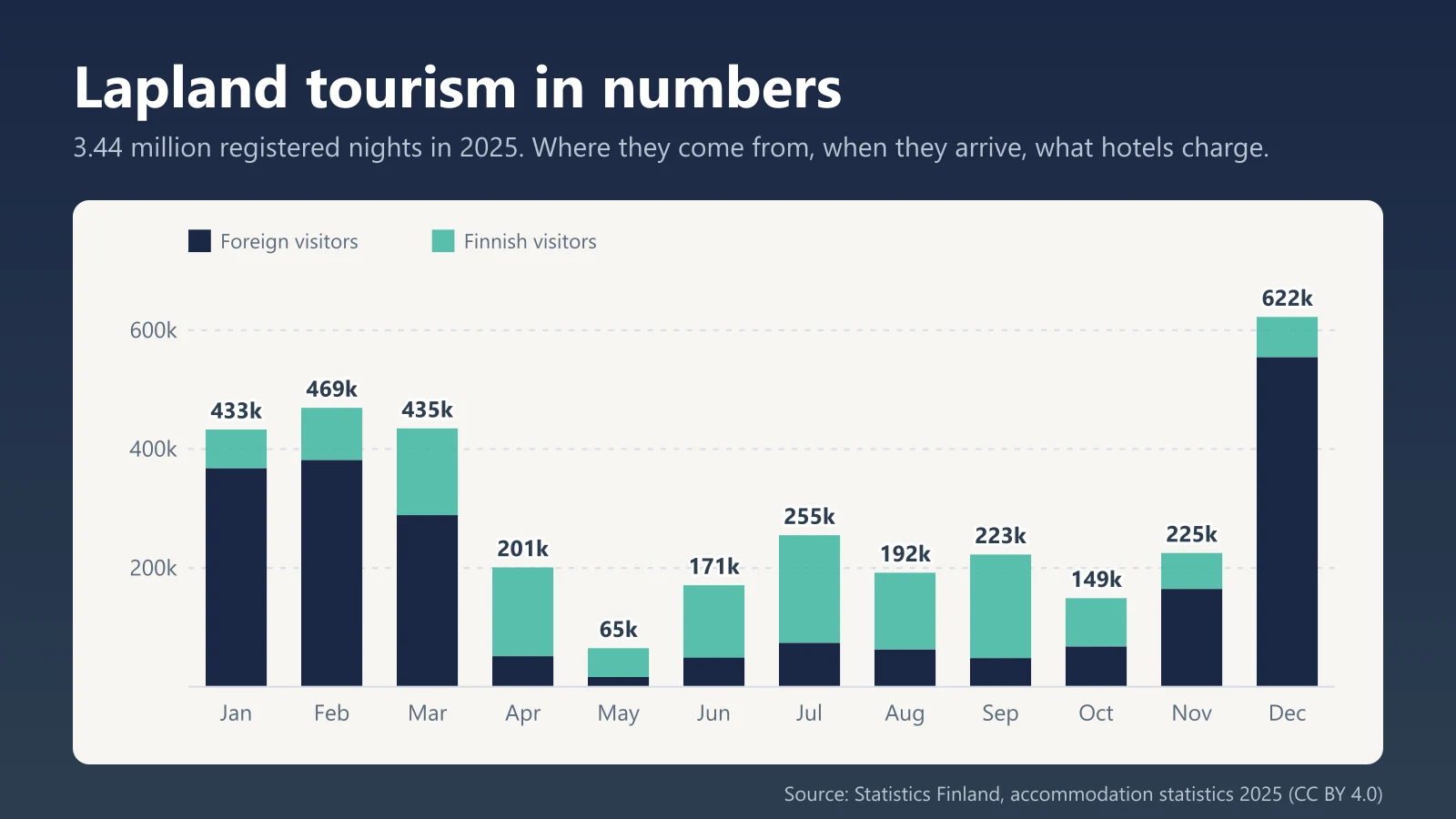
Finnish Lapland recorded 3.44 million registered overnight stays in 2025, the highest figure ever, and 61.8% of them were foreign. The year is not spread evenly: December alone brought 622,000 nights, roughly 9.6 times May’s 65,000.
If you have ever wondered why the same room costs what it costs at Christmas, that ratio is the whole answer. One caveat before the numbers. These are registered nights in accommodation establishments with at least 20 bed-places: hotels, larger holiday villages, campsites and hostels. Private cabins, Airbnb-style rentals and stays with friends are not counted at all. Every figure on this page comes from Statistics Finland, pulled from the open API on 15 September 2026.
What these figures count, and what they miss
Lapland is a region of small villages and a very large stock of private cabins. A family renting a mökki (a private holiday cottage) outside Ylläs for a week appears in nobody’s statistics. So the official series undercounts real visitor volume, and undercounts it worst in exactly the places where Finns go. What it does give you is a consistent, comparable series going back decades, which is why every tourism story about Lapland leans on it.
Arrivals, as opposed to nights, came to about 1.5 million in 2025, with an average stay of 2.3 nights. Foreign visitors stayed marginally longer than Finns, 2.4 nights against 2.2. That short average tells you something about how Lapland is sold: a three-night package built around one aurora hunt and one husky run.
How Lapland tourism grew, 2015 to 2025
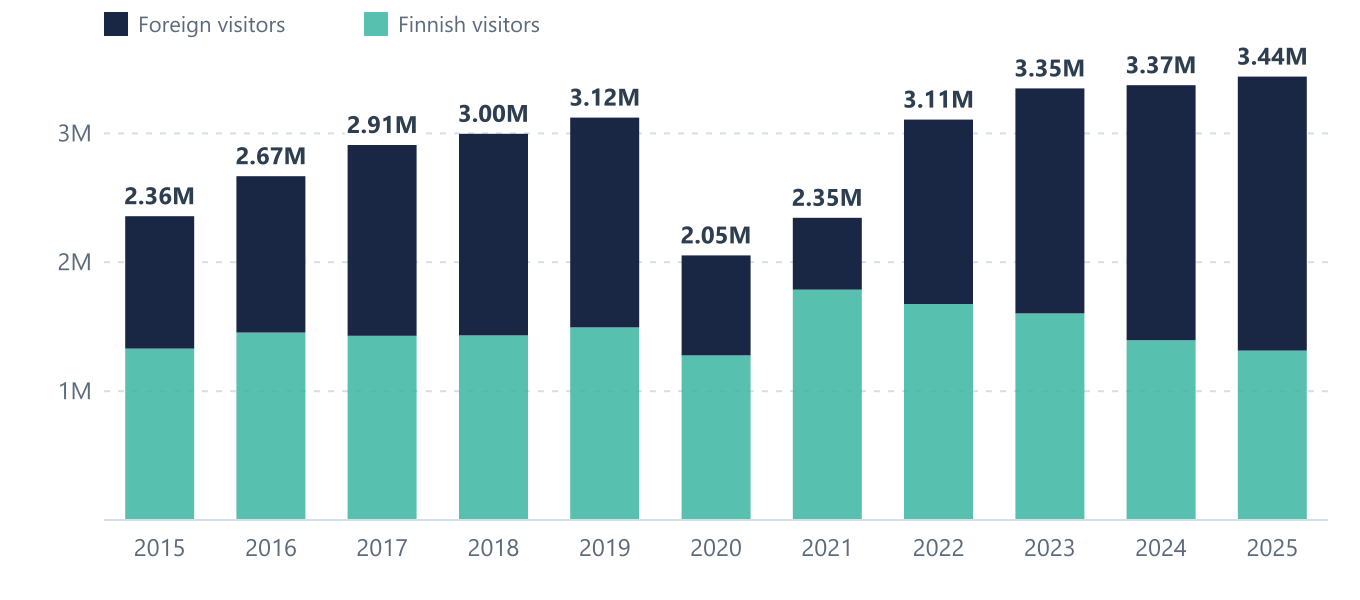
The decade splits into three parts. From 2015 to 2019, nights climbed steadily from 2.36 million to 3.12 million, driven almost entirely by foreign demand: the foreign share crossed 50% in 2017 and, pandemic years aside, has not fallen back below it since.
Then the pandemic, which hit Lapland harder than most of Finland because so much of its business flies in. 2020 fell to 2.05 million, and 2021 was worse in the way that matters, with foreign nights down to 557,000 while Finns filled the gap.
Recovery was fast and then it turned into records. 2023 passed the 2019 peak, 2024 edged higher, and 2025 finished at 3.44 million, up 10.2% on 2019 and 2% on 2024. Compared with 2015, the region is up 46%.
The composition changed more than the total. Foreign nights are 30.7% above 2019. Finnish nights are 12.1% below it. In 2015 the foreign share was 43.6%; in 2025 it was 61.8%. Lapland did not simply get busier. It swapped one clientele for another.
The shape of the year
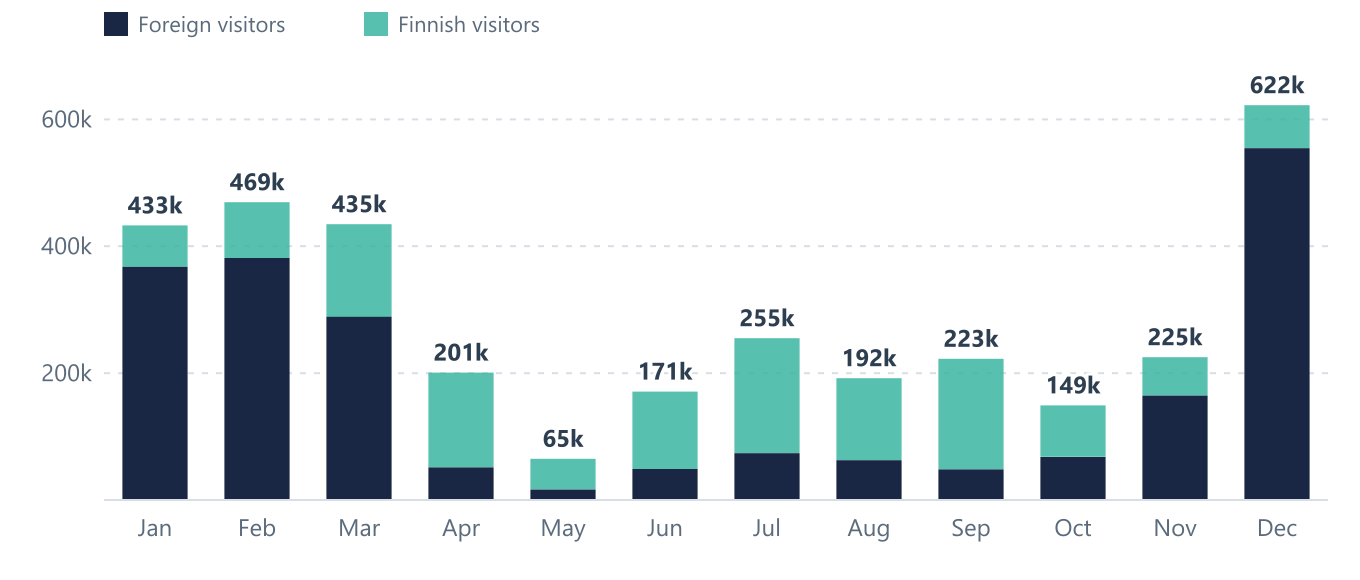
December to March carry 57% of Lapland’s entire year, and December alone is 18.1% of it at 89.1% foreign. That makes it less a season than a single, enormous, imported month.
February is the second biggest at 469,000 nights, with March and January just behind. Then the floor drops out: April halves, and May, at 64,868 nights, is the quietest month in Lapland by a wide margin.
Summer is real but modest, and it is Finnish. July is the biggest non-winter month at 255,000 nights, only 28.9% foreign. September, the ruska (autumn colour) month when the birches and the ground cover turn red and yellow, brings 223,000 nights and is the most domestic month of the year at 21.7% foreign. October is a genuine low point despite the aurora marketing.
For you as a visitor, that curve is the price list and the availability calendar in one line. Crowds, room rates and sold-out safaris follow it exactly, and the gap between two months with identical snow can be enormous.
Where visitors come from
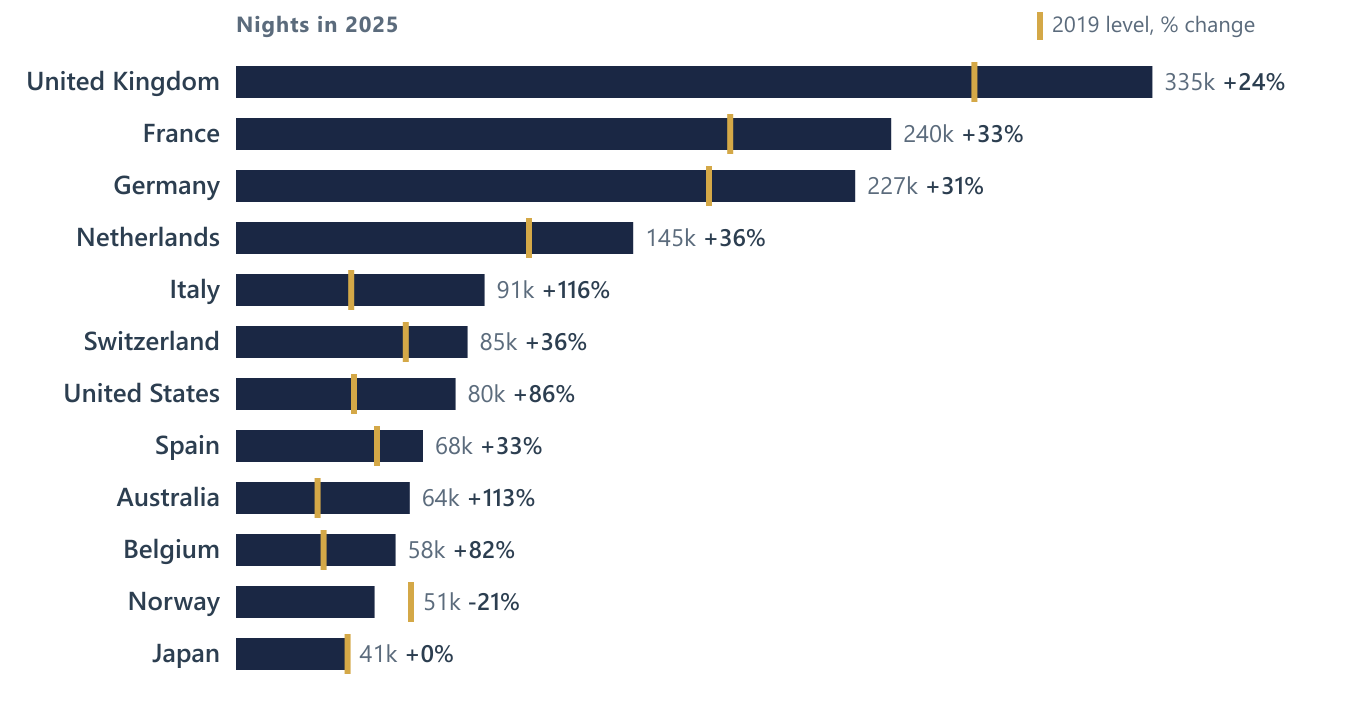
The United Kingdom is Lapland’s largest foreign market by a clear margin: 335,000 nights in 2025, 15.8% of all foreign nights, up 24.1% on 2019. France follows at 240,000 (up 32.6%) and Germany at 227,000 (up 30.9%). Those three plus the Netherlands account for roughly 45% of all foreign nights, which makes Lapland’s foreign business, in the main, a Western European business.
Growth is fastest further out. Ireland is up 213.5% on 2019, India 191%, Taiwan 149.4%, Italy 115.8%, Australia 112.9% and the United States 86.2%. These are still mid-sized markets in absolute terms, but they are the ones changing the mix of accents in a Rovaniemi hotel lobby. Poland has more than doubled, and Belgium is up 82.1%.
Three markets went the other way. China is down 55.8% on 2019 and is now smaller than India, Norway is down 20.8%, Japan is flat and Israel sits below its 2019 level. The biggest decline of all is domestic: Finnish nights fell 12.1% against 2019, in a region where Finns were once the majority of guests.
When each nationality comes
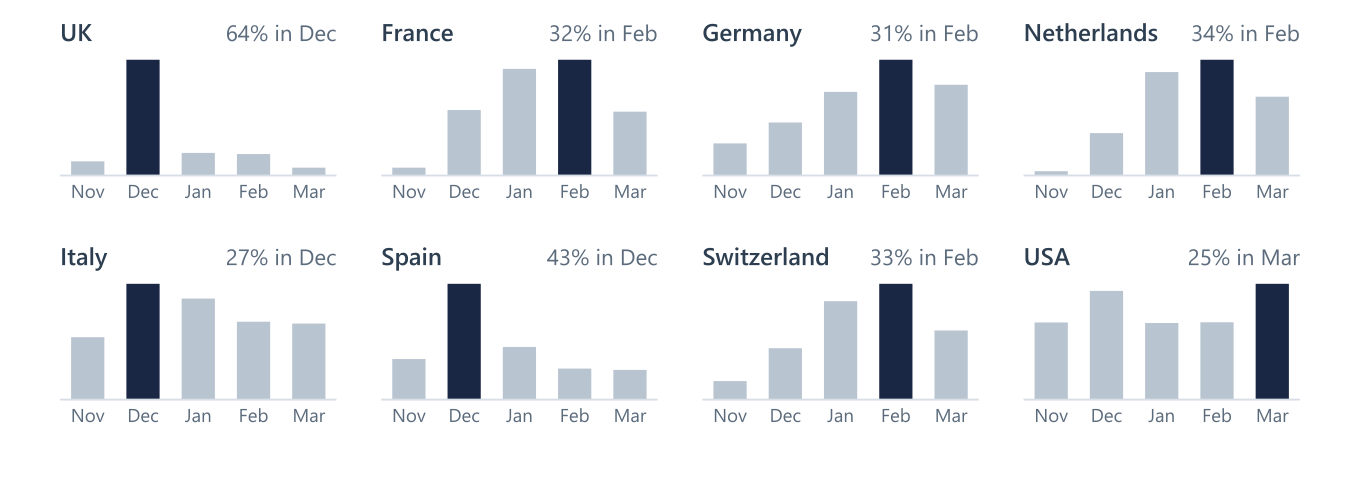
Nationalities do not share the winter evenly. Through the 2025-26 winter, 62.4% of all British nights fell in December 2025 alone: 211,000 in one month, against 41,000 in January. Christmas week is the British product, and it is the week that sells out first and prices highest.
The French, Dutch, Germans, Swiss and Belgians run on a completely different calendar. All five peaked in February 2026, with January and March close behind and December comparatively quiet. Belgium put 39% of its winter into February; the Dutch, Swiss and French each peaked at around a third. This is European school-holiday skiing behaviour applied to Lapland.
Spain and Italy straddle the turn of the year. Spain peaked in December at 40.2% of its winter nights, with a strong January; Italy spread itself across December, January, February and March with no month above 24.6%. Americans are the most evenly distributed of all, peaking mildly in March at 23.1%, and Japanese visitors spread almost flat across the entire winter.
The practical use of this is choosing a week. Book Christmas and you are in a largely British resort. Book mid-February and you are in a French, Dutch and German one. Book March and you get Americans, Germans and the last of the season’s snow, with the widest availability of the three.
What hotels actually charge, by month
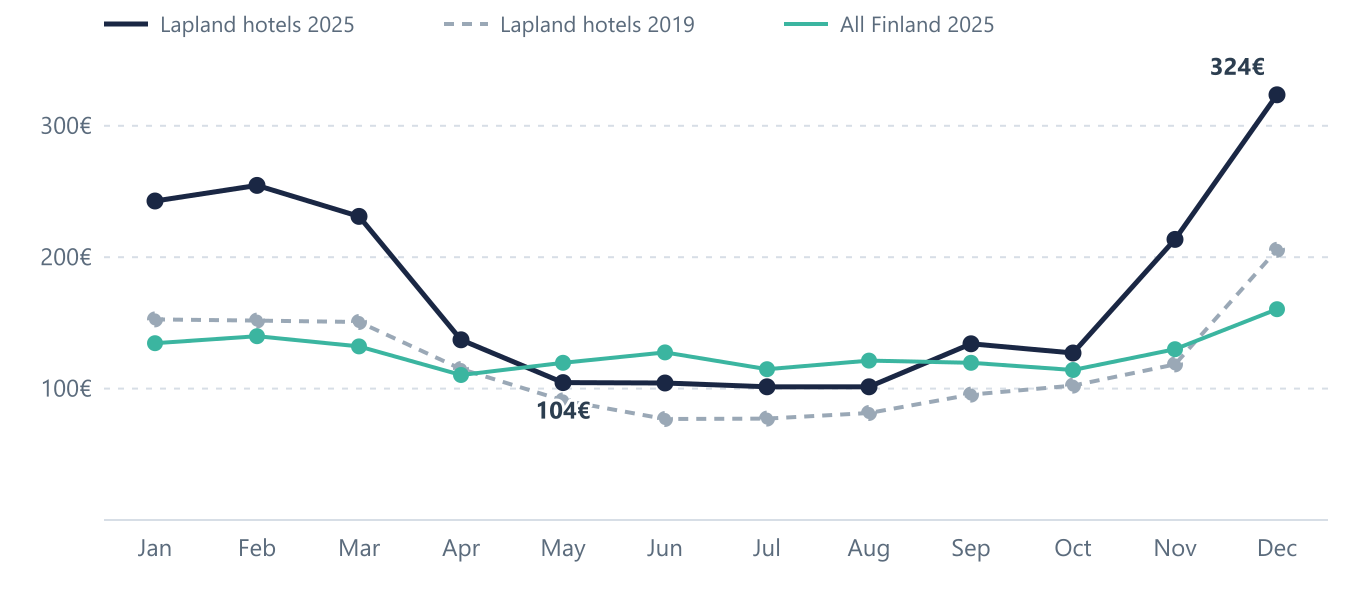
The average realised room price in Lapland in December 2025 was 323.51€ per occupied room per night, VAT included. In May 2025 it was 104.47€. The national average for Finland in December was 160.37€, so Lapland in December costs roughly twice the rest of the country.
February 2026 came in at 262.98€, January 2025 at 242.65€ and March 2025 at 231.03€: still expensive, but meaningfully below the Christmas peak. Against 2019, December is up 57.4%, from 205.54€ to 323.51€, which is far steeper than general inflation and the single clearest piece of evidence that Lapland has repriced rather than simply grown. Occupancy explains why nobody is stopping: 79% of rooms filled in December 2025 and 80.3% in February 2026, against 24.1% in May.
Be careful how you read those figures. This is a realised market average across every hotel in the region, mixing budget hotel rooms in Rovaniemi with glass igloos. It is not a rate you can book, and no hotel charges it. These are Statistics Finland’s 2025 and early 2026 realised averages, and prices change every season, so check current rates before you budget. For what a trip actually costs, use the costs guide linked below.
The resorts compared
| Area | Hotel nights 2025 | Foreign share | Change vs 2019 | Avg room, Dec 2025 | Occupancy, Dec 2025 |
|---|---|---|---|---|---|
| Rovaniemi | 802,417 | 74.8% | +16.1% | 482.04€ | 93.5% |
| Inari (Saariselkä) | 453,020 | 72.7% | +15.1% | 186.71€ | 76.0% |
| Kittilä (Levi) | 425,794 | 68.0% | +8.2% | 286.86€ | 89.3% |
| Kuusamo (Ruka) | 289,814 | 34.5% | -10.1% | 167.43€ | 78.5% |
| Sodankylä (Luosto) | 159,921 | 74.3% | -17.9% | 482.63€ | 79.9% |
Rovaniemi is the volume, with 802,417 hotel nights, nearly twice Levi’s and comfortably ahead of Saariselkä’s, and it runs at 93.5% occupancy in December at an average of 482.04€ a room. Sodankylä posts an almost identical December average off a fraction of the volume, because its stock is weighted towards high-end glass and igloo accommodation rather than ordinary hotel rooms.
Saariselkä is the surprise: strong volume, high foreign share, and the lowest December average of the three big winter destinations at 186.71€. Ruka is the outlier in the other direction, 34.5% foreign and still the most Finnish resort on the list, which shows up in both its price and its shrinking share. In June every one of them charges between 79€ and 106€.
2026 so far
Through July 2026, Lapland recorded 2,038,906 nights, up 0.5% on the same period in 2025. Foreign nights are up 1.8% and domestic nights down 1.6%, so the same trade continues at a slower pace.
These months are preliminary and get revised, and the figures that decide the year, November through March, are not in them at all. Judge 2026 in February 2027, not now.
Data and method
Every figure on this page comes from one source: Statistics Finland’s accommodation statistics, retrieved from the StatFin open API on 15 September 2026. Four tables are used: 11iz (nights by region and month), 11j1 (nights by country of residence), 11ix (regional hotel capacity, occupancy and room prices) and 11lm (municipal hotel figures). The data is licensed CC BY 4.0.
The definition matters: an accommodation establishment is counted only if it has at least 20 bed-places, so private cabins, small rentals and stays with friends are excluded throughout. “Lapland” means the region of Lapland, which is why Kuusamo and Ruka, administratively in North Ostrobothnia, appear only in the municipal table. Average room price is the realised average per occupied room per night including VAT, across all hotels in an area.
I refresh this page once a year, in late February, when Statistics Finland publishes the full previous year. Journalists and bloggers are welcome to reuse the charts with attribution to Statistics Finland and a link back here. Regional context and destination-level reporting are available from Visit Finland and Visit Rovaniemi.
Book this
Travel insurance for Lapland: cover for winter activities and medical costs from Ekta, priced per trip
Common questions
How many tourists visit Lapland each year?
Finnish Lapland recorded 3.44 million registered overnight stays and about 1.5 million arrivals in 2025, with an average stay of 2.3 nights. Those figures count only accommodation businesses with at least 20 bed-places, so private cabin and rental stays are excluded and the true number of visitors is higher.
Which country sends the most visitors to Lapland?
The United Kingdom, with 335,000 registered nights in 2025, or 15.8% of all foreign nights. France (240,000) and Germany (227,000) are second and third. The fastest-growing markets since 2019 are Ireland, India, Taiwan, Italy and Australia, all of which have at least doubled.
What is the busiest month in Lapland?
December, by a wide margin: 622,000 nights in December 2025, 18.1% of the entire year, and 89.1% of them foreign. February is second at 469,000. May is the quietest month at around 65,000 nights, close to a tenth of December.
Is Lapland getting more expensive?
Yes, sharply, and mostly in December. The average realised hotel room price in Lapland in December 2025 was 323.51€, up 57.4% from 205.54€ in December 2019. Outside the peak the rise is gentler: May 2025 averaged 104.47€ against 91.07€ in May 2019.
Best Booking Resources for Lapland
These are the booking tools I keep coming back to. They consistently offer the best prices, the most relevant options for northern Finland, and actually work well for Lapland-specific searches, which not all platforms do.
- Kiwi.com: The best source for finding flights and airport connections. I have noticed they find flight connections that other search engines miss.
- Booking.com: I almost always use them for booking hotels and apartments (and occasionally flights). They have the best filters and I like the user-friendly interface.
- Hotels.com: The most popular hotel booking platform in many countries, US included.
- Get Your Guide: A massive selection of tours and excursions, including aurora tours, husky rides, reindeer experiences and more!
- EconomyBookings: Want to explore Lapland or chase auroras yourself? They pool together the best offers from car rental operators for your convenience.
- yesim: Need a local SIM for Lapland? A stress-free holiday nowadays (unfortunately) might start from a good connection, so get an eSIM with unlimited or prepaid data.
- Ekta Traveling: Not interested in checking out the Finnish public health care system on your holiday? Didn’t think so 🙂 Good insurance gets that stress out of the way.
As an Amazon Associate I earn from qualifying purchases. Booking through these links costs you nothing extra and helps keep these guides free and up to date. Thank you!

Planning a Lapland trip?
Ask a Finn. The Lapland Trip Planning: Finland group is where readers compare dates, resorts and real prices for the coming winter.