Rovaniemi Guide: Lapland’s Gateway City
Rovaniemi is a proper city. That surprises people. They expect a snow-covered village with reindeer wandering the streets, and instead they land at an airport with a Burger King, drive past car dealerships and apartment blocks, and check into a hotel on a pedestrianised high street with cocktail bars. Around 60,000 people live here. There’s a university, a performing arts centre, an excellent museum, and restaurants that would hold their own in Helsinki. There’s also Santa Claus. Both things are true at the same time.
For most visitors, Rovaniemi is where a Lapland trip begins – and for many, it’s where the trip stays. That works well for families, short breaks, and anyone who wants Arctic experiences without complicated logistics. But I’ll be honest: the deeper Lapland – the silence, the wilderness, the feeling of being genuinely remote – starts an hour or two north of here. Rovaniemi is the gateway. Whether you walk through that gate or set up camp beside it depends on what you’re after.
What Rovaniemi actually is
Rovaniemi sits almost exactly on the Arctic Circle, which is the whole reason Santa Claus Village exists here (the marketing logic being: Santa lives at the North Pole, and the Arctic Circle is the closest famous line to that). The city was almost entirely destroyed in 1944 during the Lapland War and rebuilt from scratch – the city centre was designed by Alvar Aalto, Finland’s most famous architect, in the shape of a reindeer’s head and antlers. You can’t see this from the ground, but it’s a fun fact for the plane.
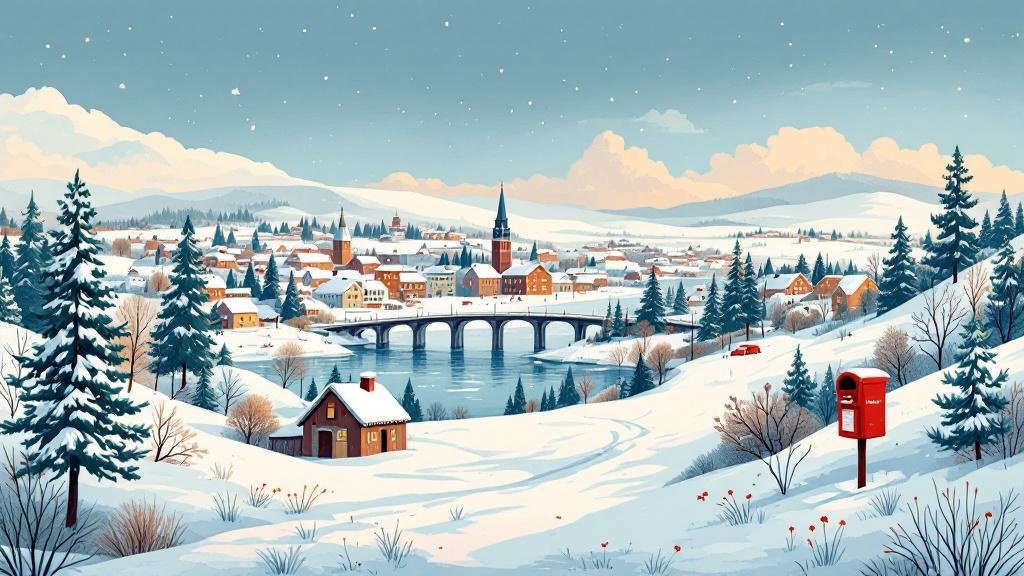
The Kemijoki and Ounasjoki rivers meet here, which gives the city its character. The Jätkänkynttilä (Lumberjack’s Candle) bridge is the most photographed thing in town – an eternal flame burns between its two pillars. In winter, the frozen rivers become snowmobile routes and skiing tracks. In summer, midnight sun turns the riverbanks into a surprisingly lively outdoor scene.
This is not a resort town. People live and work here year-round. That means the restaurants, cafés, and services exist because residents need them, not just tourists. The result is better quality and lower prices than you’d find in a pure tourism destination.
Santa Claus Village
Let’s get this out of the way first, because it’s the reason most people have heard of Rovaniemi. Santa Claus Village is 8 km north of the city centre, right on the Arctic Circle line (there’s a painted line on the ground and everything – you will take a photo of it).
The village itself is free to enter. You can walk around, cross the Arctic Circle, visit the post office, browse the shops, and soak up the atmosphere without spending a cent. What costs money: the photo with Santa (expect to pay for a professional package), the various activity add-ons, and the souvenir shops that are strategically impossible to avoid.
In December, the village is packed. Genuinely crowded, queue-for-everything, wear-your-patience packed. If your trip is primarily about Santa, this is the trade-off: maximum Christmas atmosphere, maximum crowds. In January or March, you get the same village with a fraction of the visitors.
Beyond Santa: things to do in Rovaniemi
The Arktikum museum is genuinely excellent. I’m not saying that in a “oh, it’s nice for a rainy day” way – I mean it’s one of the best museums in Finland. The building itself is striking: a long glass tube stretching towards the Ounasjoki river. Inside, the exhibitions cover Arctic science, Lapland’s history, and Sámi culture with a depth and honesty that’s rare in tourist-town museums. Budget at least two hours.
Pilke Science Centre, right next door, focuses on northern forests and sustainability. It’s more hands-on and works well for families. Between the two, you could spend a full morning or afternoon.
For sauna – and you should do sauna – Rovaniemi has several options. The municipal swimming hall offers the budget experience at 7-10€. For something more memorable, Sauna World has eight different saunas, pools, and ice dipping; prices range from around 65€ via booking platforms to 185€ direct. WNTR Sauna, which opened in 2023, has a riverside location. For the most traditional experience, Heishala does wood-fired riverside sauna the way Finns have done it for generations.
Activity-wise, Rovaniemi has the full Lapland menu available on its doorstep. Prices are for the 2025-26 season and change annually – check operator websites or booking platforms for current rates.
| Activity | Duration | Price range | Notes |
|---|---|---|---|
| Husky safari (short ride) | 30 min | 50-65€ | Musher-driven, Santa Claus Village area |
| Husky safari (self-driven) | 1.5-2 hr | 110-125€ | You drive the sled – the real experience |
| Reindeer farm + sleigh ride | 2-3 hr | 85-139€ | SieriPoro 139€/95€ child, Santa Claus Reindeer 125€/85€ child |
| Snowmobile safari | 2 hr | 128-160€ | Shared sled; solo supplement +60-65€ |
| Northern lights tour | 4-6 hr | 145-210€ | Small group; private tours 250€+ |
| Ice fishing (guided) | 3 hr | From 89€ | Includes gear, campfire snacks, hot drinks |
| Ice fishing (DIY) | As long as you want | Free | Under jokamiehenoikeus (everyman’s right) with simple gear |
If this is your first Lapland trip, booking through a platform gives you free cancellation and English-language support – worth the small premium when you’re organising from abroad. If you’ve been before and know exactly which operator you want, booking direct saves 10-20%. Operators like Bearhill Husky (strong animal welfare credentials) and SieriPoro Safaris (a reindeer herding family since the 1800s) are well-established names in the Rovaniemi area.
Where to stay in Rovaniemi
Rovaniemi has the widest range of accommodation in Lapland, from 29€ dorm beds to 500€+ luxury suites. City centre hotels are genuinely good value compared to resort destinations further north.
| Category | Price per night | What to expect |
|---|---|---|
| Hostel | 29-95€ | Hostel Cafe Koti: dorms from 29€, private rooms 80-95€ |
| Budget hotel | 80-130€ | Clean, central, functional |
| Mid-range hotel | 130-250€ | Santa’s Hotel Santa Claus on the main street; comfortable city hotel |
| Luxury / boutique | 290-500+€ | Arctic Light Hotel – boutique, city centre, consistently top-rated |
| Glass igloo (nearby) | 240-850€ | Arctic SnowHotel (Sinettä, 25 min) or Apukka Resort (30 min) |
| Unique | 290-500+€ | Arctic TreeHouse Hotel – wooden pods on stilts, glass north-facing walls |
The Arctic TreeHouse Hotel is the standout unique stay – architecturally beautiful wooden pods perched on a hillside with glass walls facing north. It’s the kind of place you see on Instagram and assume costs a fortune, and it does cost a fortune, but it’s genuinely special.
For glass igloos: book six months ahead for December through February. March availability is much better and prices drop 30-40%. Christmas week (December 20 – January 2) requires booking nearly a year in advance, with prices running 2.5-3x normal rates.
Most cabins in the area come with a sauna and kitchen. Self-catering saves 30-40€ per day on food, which adds up fast on a week-long trip.
Getting to Rovaniemi
Rovaniemi has the best transport connections in Lapland. This is one of its biggest practical advantages.
By air: Rovaniemi Airport (RVN) has direct flights from Helsinki year-round and seasonal direct flights from several European cities, including UK airports, during winter. From the US, you’ll connect through Helsinki (sometimes via London or Reykjavik). The airport is 10 km from the city centre. Check Finavia for current routes and schedules.
By train: The overnight Santa Claus Express from Helsinki is the classic way to arrive. Departs Helsinki around 18:00-19:00, arrives Rovaniemi at 06:00-08:00. Twelve hours, one sleep, and you wake up in the Arctic. Prices start from 23€ for a seat, from 49€ for a two-person sleeping cabin, or from 74€ for a cabin with shower and WC. Sleeping cabin prices are per cabin, not per person – so two people sharing a 49€ cabin is excellent value. Peak winter pushes cabin prices to 150-220€, and the train books out weeks ahead in December and February. Children under 11 travel free in an adult’s bed.
By bus: Buses connect Rovaniemi to the rest of Lapland. Several daily services run to Levi (about 2.25 hours, 25-45€), and there are connections to Saariselkä (3.5 hours, 45-51€) and Inari (5 hours, 50-60€).
Day trips from Rovaniemi
Rovaniemi’s central position makes it a good base for exploring further without changing hotels. Here’s what’s within reach:
| Destination | Distance | Drive time | Why go |
|---|---|---|---|
| Luosto / Pyhä | 120 km | 1.5 hr | Amethyst mine, fell hiking, quieter wilderness |
| Levi | 170 km | 2 hr | Ski resort, activities, livelier village scene |
| Muonio | 220 km | 2.5 hr | Some of Lapland’s best husky farms |
| Saariselkä | 260 km | 3 hr | Urho Kekkonen National Park, fell walks |
| Inari | 330 km | 4 hr | Sámi culture centre, Lake Inari, real remoteness |
Luosto is the easiest day trip – close enough for a relaxed round trip. Levi works as a day trip too, though two hours each way starts to eat into your day. Anything beyond Levi is really better as an overnight. Inari at four hours is technically possible as a day trip, but you’d spend eight hours driving for a few hours there, which rather defeats the purpose of visiting one of Lapland’s quietest places.
If you don’t have a car, most activities include hotel pickup from Rovaniemi. Guided day trips to further-flung destinations are available through local operators, though they’re more expensive than self-driving.
Who Rovaniemi suits – and who should go further north
Rovaniemi is ideal for:
- Families with young children – Santa Claus Village, easy logistics, short transfer from airport
- Short breaks (2-3 nights) – enough to see and do without complicated transport
- First-time visitors who want a taste of everything Lapland offers
- Travellers who prefer city comforts – restaurants, bars, shops, museums
Consider going further north if:
- Wilderness and silence are what you’re after – Rovaniemi is a city, not the wild
- You want serious aurora hunting – less light pollution further north
- You’re looking for a ski holiday – Levi, Ylläs, and Saariselkä have the slopes
- You’ve already been to Rovaniemi and want deeper Lapland
There’s no wrong answer here. Plenty of people have excellent Lapland holidays based entirely in Rovaniemi, especially families on shorter trips. But if you have five or more days, spending two nights in Rovaniemi and then heading north gives you the best of both: city conveniences plus genuine Arctic wilderness.
Is Rovaniemi worth visiting or should I go straight to Levi?
It depends on your priorities. Rovaniemi has better transport connections, Santa Claus Village, the Arktikum museum, and more restaurant and nightlife options. Levi has ski slopes, a resort village atmosphere, and easier access to wilderness. For families with young children, Rovaniemi usually wins. For skiing or aurora hunting, Levi often makes more sense.
How cold is Rovaniemi in winter?
January averages around −8°C (18°F) during the day and −17°C at night, with cold snaps dropping to −35°C. But the dry Arctic air feels less harsh than a wet, windy 0°C day in London. Activity operators provide thermal oversuits, and you’ll be indoors or in heated transport between activities.
Can you see the northern lights from Rovaniemi?
Yes, but city light pollution reduces your chances. Drive 15-20 minutes outside the city for much better viewing. September through March is aurora season, with the darkest months (November–January) offering the most viewing hours. Check the FMI aurora forecast before heading out.
How many days do you need in Rovaniemi?
Two to three nights covers Santa Claus Village, the Arktikum museum, a couple of activities, and a sauna experience. If you’re using Rovaniemi as a base for day trips, four to five nights gives you time to explore further without changing hotels.
Best Booking Resources for Lapland
After years of travelling to and around Lapland, these are the booking tools I keep coming back to. They consistently offer the best prices, the most relevant options for northern Finland, and actually work well for Lapland-specific searches — which not all platforms do.
- Skyscanner – The best flight search engine for Lapland routes. It catches the budget airlines and seasonal charters that other search tools miss, and the price alerts are genuinely useful for spotting deals on Helsinki-Rovaniemi or direct UK routes.
- VR Finnish Railways – The only way to book Finland’s overnight trains. The Santa Claus Express from Helsinki to Rovaniemi is an experience in itself — book early for the cabin berths, they sell out weeks ahead in peak season.
- DiscoverCars – Compares all the major rental companies at Lapland airports in one search. Crucially, they show which rentals include studded winter tyres — mandatory in Lapland and a detail other comparison sites bury in the fine print.
- Booking.com – Has the widest selection of Lapland accommodation by far, including cabins, glass igloos, and small family-run guesthouses that don’t list elsewhere. Free cancellation on most properties makes it low-risk for planning ahead.
- GetYourGuide – The largest marketplace for Lapland activities: husky safaris, snowmobile tours, aurora trips, reindeer visits. You can compare operators and prices side by side, and most bookings are cancellable up to 24 hours before.
- SafetyWing – Travel insurance designed for adventurous trips. Covers winter sports, extreme cold activities, and medical evacuation — all relevant when you’re snowmobiling at -25°C. Affordable and the claims process is straightforward.
- Holafly – eSIM that works in Finland from the moment you land. No hunting for local SIM cards at the airport, no roaming surprises. Set it up on your phone before departure and you’re connected in Lapland immediately.
Some of the links above are affiliate links — if you book through them, I earn a small commission at no extra cost to you. I only recommend services I genuinely use and trust for Lapland travel.