Driving in Lapland: Winter Roads, Reindeer, and Survival Tips
Finnish winter roads are better maintained than most countries’ summer roads. That sentence surprises people, but it’s true. Finland has been dealing with snow since forever, and the road maintenance system is built around the assumption that it will snow, ice over, and drop to −30°C (−22°F) for months at a time. Gritters and ploughs run 24 hours. Roads are salted and sanded on schedule. The result is that driving in Lapland – even in the dead of winter – is not the white-knuckle survival experience you might be imagining.
That said, it’s not the same as driving at home. The roads are snow-packed, reindeer genuinely do not care about your car, and fuel stations in the far north can be over 100 km apart. You need to adjust your driving style and expectations. Here’s everything you need to know.
Winter Road Conditions: Better Than You Think
Between November and April, Lapland’s roads are covered in compacted snow and ice. This is normal. The roads aren’t ploughed down to bare tarmac – instead, the snow is packed into a firm, even surface that’s regularly maintained. Think of it as driving on a carefully maintained ice rink rather than an untreated country lane after a surprise snowfall.
Finnish road maintenance is divided into priority classes. The main highways connecting Rovaniemi, Levi, Saariselkä, and Inari are top priority – ploughed and gritted within hours of snowfall. Smaller roads between villages take longer, but they’re still maintained to a standard that would impress anyone used to rural roads in the UK or northern US.
The one exception is during active heavy snowfall. When a proper storm moves through, visibility drops and even ploughed roads get covered quickly. If this happens, slow down dramatically or pull over. There’s no shame in waiting it out at a roadside café.
Studded Tyres: Mandatory and Already Sorted
Studded winter tyres are mandatory in Finland from November through March, and most years people keep them on through April. This isn’t optional – it’s the law, and it makes an enormous difference. Studded tyres bite into ice in a way that regular winter tyres simply can’t match.
The good news: you don’t need to worry about this. Every rental car in Lapland comes with studded tyres during the winter season. You don’t need to request them, pay extra, or check a box. They’re standard. When you pick up your car, the winter tyres are already on it.
If you’re driving your own car up from Central Europe, you’ll need to fit studded tyres before crossing into Finland in winter. Some people swap them in Tornio at the Swedish border, but honestly, if you’re driving from the UK or mainland Europe, flying and renting locally is far easier.
Speed Limits and How to Actually Drive
Speed limits in Lapland are typically 80 km/h on main highways outside towns and 40-50 km/h within built-up areas. Some stretches of the E75 (the main north-south highway) allow 100 km/h in summer, but winter limits often drop to 80 km/h.
Here’s the thing: the posted speed limit is the maximum, not a target. In winter, most experienced local drivers cruise at 60-70 km/h on roads that are technically 80 km/h. Nobody will flash their lights at you for going slower than the limit. If anything, driving at the full posted speed on a snowy road marks you as someone who hasn’t done this before.
| Situation | Recommended Speed | Notes |
|---|---|---|
| Clear day, maintained highway | 70-80 km/h | The most you should do in winter |
| Light snowfall, good visibility | 50-60 km/h | Snow reduces grip even on studded tyres |
| Heavy snowfall or poor visibility | 30-40 km/h | If you can’t see 100 m ahead, slow right down |
| Town centres | 30-40 km/h | Pedestrians, reindeer, and icy intersections |
| Reindeer on road | 0 km/h | Stop. Wait. They’ll move when they’re ready |
A few practical driving tips. Brake gently and early – slamming the brakes on ice does nothing useful. Steer smoothly. Leave three to four times more following distance than you would on dry tarmac. And if you feel the car start to slide, ease off the accelerator and steer into the direction you want to go. Don’t overcorrect.
Reindeer: They Have Right of Way
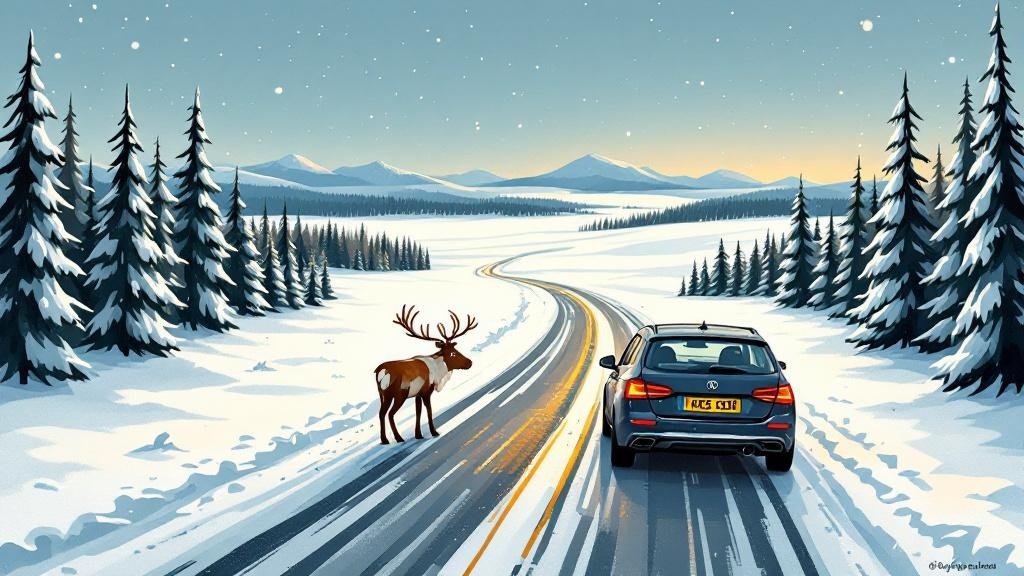
There are roughly 200,000 semi-domesticated reindeer in Finnish Lapland, and they roam freely across roads. They are not fenced in. They don’t follow traffic signals. They don’t flinch at oncoming headlights. A reindeer will stand in the middle of the road, stare at you with complete indifference, and move only when it decides to move.
This is not an exaggeration. It’s a daily reality. In the Inari-Saariselkä area especially, you will encounter reindeer on the road. It’s not a question of if, it’s when.
What to do: slow down, stop if needed, and wait. Don’t honk aggressively – they don’t respond to it and you’ll just annoy the reindeer herder who probably owns them. Where there’s one reindeer, there are usually more. After the first one crosses, wait 30 seconds before proceeding, because a second group often follows.
If you hit a reindeer, you’re legally required to report it. Call 112 (the Finnish emergency number, same as the EU standard) and they’ll connect you with the local reindeer herding cooperative. All reindeer are owned by someone – they’re livestock, not wildlife – and there’s an established process for dealing with collisions.
The highest risk times are dawn and dusk, and the months of September through November when herders are doing their annual roundups and reindeer are moving in large groups.
Fuel Stations and Distances
In southern Lapland – the Rovaniemi-Levi-Luosto triangle – fuel stations are reasonably common. You’ll find them in every town and at most major junctions. Fill up when you see one, but you won’t be stranded.
North of Sodankylä, the gaps grow. Between Inari and Kilpisjärvi, or on the road from Enontekiö to Kautokeino (into Norway), you can easily go 100 km or more without seeing a station. In winter, with heaters running and headlights on constantly, fuel consumption is higher than normal.
The rule is simple: never let your tank drop below half. Top up in every town you pass through. It costs you two minutes and saves you the genuine stress of watching the fuel gauge drop on a 180 km stretch of empty road with no phone signal.
Most fuel stations in Finland are automated and accept international credit or debit cards. Some unmanned stations require a PIN, so make sure you know yours. Cash is almost never needed – Finland runs almost entirely on cards.
Driving Distances Between Lapland Destinations
Lapland is big. People consistently underestimate the distances. Here are the main routes, with winter driving times (add roughly 20-30% to what Google Maps suggests for summer).
| Route | Distance | Winter Driving Time |
|---|---|---|
| Rovaniemi → Levi | 170 km | ~2 hours |
| Rovaniemi → Luosto | 120 km | ~1.5 hours |
| Rovaniemi → Muonio | 220 km | ~2.5 hours |
| Rovaniemi → Saariselkä | 260 km | ~3 hours |
| Rovaniemi → Inari | 330 km | ~4 hours |
| Rovaniemi → Kilpisjärvi | 420 km | ~5 hours |
| Levi → Muonio | 80 km | ~1 hour |
| Levi → Saariselkä | 160 km | ~2 hours |
| Levi → Inari | 230 km | ~3 hours |
| Saariselkä → Inari | 35 km | ~30 min |
| Muonio → Kilpisjärvi | 180 km | ~2 hours |
| Inari → Kilpisjärvi | 280 km | ~3.5 hours |
The Saariselkä to Inari run is a quick 35 km – easy to combine as a day trip. But Rovaniemi to Kilpisjärvi is a full five-hour winter drive across some genuinely remote territory. Plan accordingly.
Driving in the Dark
In December and January, northern Lapland gets almost no daylight. Inari has zero sunrise between mid-December and mid-January – a period Finns call kaamos, the polar night. Even Rovaniemi, further south, gets only 2-3 hours of dim twilight around midday in late December.
This means you’ll be driving in the dark. A lot. Headlights are mandatory at all times in Finland (your rental car will have them on automatically), but you need to think about what darkness means for winter driving. You see reindeer later. You judge road conditions by feel rather than sight. Everything takes a bit more concentration.
A few things that help: keep your headlights clean (they get covered in road spray and frost), use high beams whenever there’s no oncoming traffic, and don’t rely on GPS alone for navigation – road signs reflect well and help confirm you’re on the right route. If you’re tired, stop. Driving fatigued on a dark, snowy road is how accidents happen.
By March, you’ll have 10+ hours of daylight and brilliant sunshine reflecting off white snow. Sunglasses become essential – snow blindness is a real thing. The contrast between December kaamos driving and March spring driving is enormous.
What to Keep in the Car
Finnish drivers carry a few essentials in winter. You should too.
- Phone charger (car adapter) – cold kills phone batteries fast, and your phone is your emergency lifeline
- A warm blanket or extra jacket – if you break down and the engine stops, the car cools to outside temperature within 30 minutes
- A small shovel – for digging out if you slide off the road into a snowbank (it happens)
- A torch/flashlight – for checking the car or reading signs in the dark
- Snacks and water – if you’re driving remote stretches where help might take a while
- Windscreen scraper and brush – rental cars usually have these in the boot, but check before you leave
Your rental car will have a working heater, studded tyres, and a full tank at pickup. Most also come with a block heater cable – if you’re staying at a cabin or hotel with outdoor parking, plug it in overnight. In extreme cold, an engine that hasn’t been plugged in may struggle to start. Look for the posts in parking areas with electrical outlets – that’s what they’re for.
Summer Driving: A Completely Different Experience
Everything above is about winter. Summer driving in Lapland is another story entirely. From June to August, roads are dry, daylight is effectively 24 hours (the midnight sun doesn’t set above the Arctic Circle), and the biggest challenge is staying awake because the scenery is so monotonously beautiful that you zone out.
Speed limits are slightly higher in summer. Road surfaces are excellent. You don’t need special tyres – regular summer tyres are standard on rental cars from May onwards. The only wildlife issue shifts from reindeer (still present, but less concentrated on roads) to the occasional moose, which is a more serious collision risk because of their size.
Summer is when many Finns do road trips through Lapland. The driving is easy, relaxed, and scenic. If winter driving intimidates you, consider a summer trip instead – you get the midnight sun, hiking, and the same incredible landscapes without any of the winter driving complexity.
The in-between months – October and April/May – are the trickiest. The roads transition between seasons, with patchy ice, slush, and unpredictable conditions. Finns call the spring breakup kelirikko, which roughly translates as “the season when roads give up.” Some gravel roads in remote areas may be temporarily closed during spring thaw.
Do You Actually Need a Car?
Honestly? It depends where you’re based. In Rovaniemi, Levi, or Saariselkä, most activity operators offer hotel pickup and the resorts are walkable. You can manage without a car, especially if you’re there for a short trip focused on booked activities.
But a car changes the trip completely. It lets you chase the northern lights when the sky clears at 11 pm. It lets you stop at a frozen lake just because it looks incredible. It lets you drive the 35 km from Saariselkä to Inari for lunch and back. And for reaching more remote spots like Kilpisjärvi or Enontekiö, a car is essentially the only practical option.
Rental cars in Lapland run roughly 50-80€ per day as of the 2025-26 season – prices change annually, so check current rates when you’re ready to book. Book early for March, when Finnish domestic demand for Lapland ski holidays pushes availability and prices up.
Frequently Asked Questions
Is it safe to drive in Lapland in winter?
Yes. Finnish roads are maintained to a very high standard, and all rental cars come with studded winter tyres. The main adjustments are driving slower than you normally would, braking gently, and leaving extra following distance. Thousands of tourists drive in Lapland every winter without incident – respect the conditions and you’ll be fine.
Do I need an international driving licence for Finland?
If your licence is from the UK, US, Canada, Australia, or any EU/EEA country, your normal licence works fine. Finland accepts all licences written in Latin script. If your licence uses a different script (e.g. Japanese, Arabic), you’ll need an International Driving Permit alongside it.
What happens if I hit a reindeer?
Call 112 immediately – it’s a legal requirement. The dispatcher will connect you with the local reindeer herding cooperative. Don’t try to move the reindeer yourself. Your rental car insurance typically covers animal collisions, but check your policy’s excess. Herders will handle the reindeer; you handle the car and the paperwork.
Are petrol stations easy to find in Lapland?
In the southern Lapland triangle (Rovaniemi-Levi-Luosto), yes – you’ll find fuel in every town. Further north, gaps between stations can exceed 100 km. Keep your tank above half at all times, and top up whenever you pass through a town. Stations are automated and accept international bank cards.
Can I drive from Helsinki to Lapland?
You can, but it’s about 830 km to Rovaniemi alone – roughly 10-12 hours in winter conditions. Most visitors fly (1.5 hours) or take the overnight train (12 hours). If you do drive, break the journey in Oulu, which is roughly halfway. The road is well-maintained all the way, just long.
Winter driving in Lapland isn’t something to fear – it’s something to prepare for. Slow down, keep your tank full, give the reindeer their space, and you’ll discover why having a car is the best way to see this part of the world on your own terms.
Best Booking Resources for Lapland
After years of travelling to and around Lapland, these are the booking tools I keep coming back to. They consistently offer the best prices, the most relevant options for northern Finland, and actually work well for Lapland-specific searches — which not all platforms do.
- Skyscanner – The best flight search engine for Lapland routes. It catches the budget airlines and seasonal charters that other search tools miss, and the price alerts are genuinely useful for spotting deals on Helsinki-Rovaniemi or direct UK routes.
- VR Finnish Railways – The only way to book Finland’s overnight trains. The Santa Claus Express from Helsinki to Rovaniemi is an experience in itself — book early for the cabin berths, they sell out weeks ahead in peak season.
- DiscoverCars – Compares all the major rental companies at Lapland airports in one search. Crucially, they show which rentals include studded winter tyres — mandatory in Lapland and a detail other comparison sites bury in the fine print.
- Booking.com – Has the widest selection of Lapland accommodation by far, including cabins, glass igloos, and small family-run guesthouses that don’t list elsewhere. Free cancellation on most properties makes it low-risk for planning ahead.
- GetYourGuide – The largest marketplace for Lapland activities: husky safaris, snowmobile tours, aurora trips, reindeer visits. You can compare operators and prices side by side, and most bookings are cancellable up to 24 hours before.
- SafetyWing – Travel insurance designed for adventurous trips. Covers winter sports, extreme cold activities, and medical evacuation — all relevant when you’re snowmobiling at -25°C. Affordable and the claims process is straightforward.
- Holafly – eSIM that works in Finland from the moment you land. No hunting for local SIM cards at the airport, no roaming surprises. Set it up on your phone before departure and you’re connected in Lapland immediately.
Some of the links above are affiliate links — if you book through them, I earn a small commission at no extra cost to you. I only recommend services I genuinely use and trust for Lapland travel.